
Read DeKalb County Deed Records
The DeKalb County Judge of Probate keeps the deed books. The office records mortgages, liens, releases, plats, UCC filings, and miscellaneous instruments alongside deeds. Each deed image carries the full legal language, while the instrument type tells you which interest a filing addresses.
| Deed Type | What It Does | Common Use |
|---|---|---|
| Warranty deed | Conveys title with stated covenants | Ordinary sale |
| Quitclaim deed | Conveys the grantor's existing interest | Family or title cleanup |
| Executor deed | Transfers estate property under authority | Probate transfer |
| Foreclosure deed | Records a forced-sale transfer | Foreclosure trail |
| Tax deed | Documents a tax-sale interest | Delinquent-tax research |
A mortgage or lien is an encumbrance, meaning a claim or burden on the land rather than a transfer of ownership. Search releases and satisfactions too. A deed may name the grantee while an unreleased mortgage, easement, restriction, or judgment sits elsewhere in the index under a different instrument type.
Search the DeKalb Probate Index
The official Probate records application lets you search by instrument category, party name, and date. Begin with broad deed categories. Then inspect the type, book and page, recording date, parties, and image pages for each result. Legacy labels are sometimes shortened. Picking a narrow type can hide a filing you actually need.
| Search field | How to use it | Check |
|---|---|---|
| Category | Deed, mortgage, plat, lien, miscellaneous | Exact instrument label |
| Party | Surname or entity variants | Grantor and grantee roles |
| Date | Widen around the expected transfer | Recorded timestamp |
| Reference | Book/page or instrument number | Available image pages |
Search both sides of the transaction. Common surnames demand extra care, so bring a legal description, a parcel clue, a related party, or nearby dates to keep from joining the wrong chain.
The public Probate search presents those instrument and party controls in one workspace.
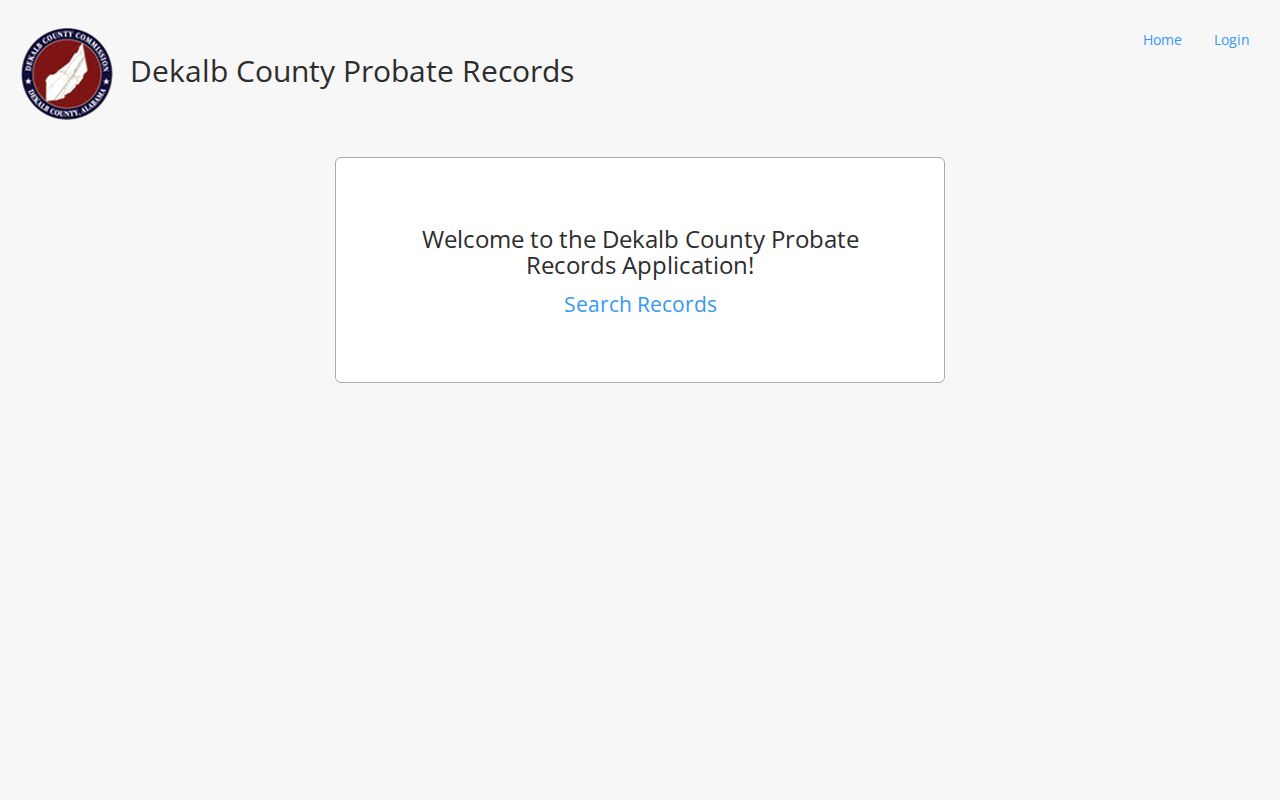
The official search page displays deeds through indexed criteria first. A specific instrument image opens only after the index narrows the results.
Instrument 4668 Reveals Index Gaps
One sample deed, instrument 4668 in book 3005, was recorded on July 14, 2025. Its detail view shows parties and image-page identifiers. The legal-description and amount fields sit blank. Blank summary fields do not mean the deed omitted those terms. The recorded image decides. Treat every empty grid cell as unknown. Never infer that no consideration, acreage, restriction, or description exists until you read the instrument itself.
DeKalb Deed Images and Copies
You can search the free index without buying an image. Probate configuration lists guest images at $1 per page. It adds an IMS charge. Purchase access lasts 36 hours. At the courthouse, copies run $1 per page and certification $3. Confirm current charges before ordering. The recording office sits at 300 Grand Avenue SW, Suite 100, Fort Payne. It answers 256-845-8510 from 8:00 a.m. to 4:00 p.m. on weekdays. A mail or counter request should include parties, type, and date. Add the book/page or instrument number.
How Old Are Online DeKalb Deeds
The public interface presents 1947 as the deed starting point. Yet an unbounded official API query returns Smith entries from 1919. A hard online cutoff is therefore unsafe, so verify category coverage with Probate. For older deed records, ask about courthouse books and indexes. The Alabama Department of Archives and History microfilm search offers another channel. Holdings vary, though, and most originals remain local.
Follow DeKalb's Grantor-Grantee Chain
A grantor gives an interest and a grantee receives it. Chain of title is the ordered sequence of transfers for one piece of land. Start with the newest confirmed deed and work backward through the index.
- Find the present owner's acquisition deed.
- Read its grantor and exact legal description.
- Search that grantor as an earlier grantee.
- Repeat while recording dates, types, books, and pages.
- Move to old books or microfilm when web results end.
- Grantor
- The party transferring an interest.
- Grantee
- The party receiving it.
- Chain of title
- The linked run of transfers for the land.
- Book/page and instrument number
- References pointing to a filed document.
Estates, divorces, foreclosures, and quiet-title suits can interrupt a simple deed chain. When a deed cites an order, a personal representative, a sheriff, or a judicial sale, search the related Probate estate or the DeKalb Circuit Clerk court file.
From Lebanon Books to Fort Payne
DeKalb County was formed in 1836. Lebanon served as the first permanent courthouse seat for 38 years. Fort Payne then became the county seat on May 5, 1878. The current courthouse is one of three used in Fort Payne since the move. That history makes it worth checking Probate, older local books, ADAH microfilm, and archive catalogs. Check them whenever the electronic trail stops. Probate publishes no schedule of courthouse fires or lost books. Confirm any gap with the custodian.
Historic Names in DeKalb Deeds
Railroad growth changed the names that appear in local land records. Rainsville history includes the promoted name Santileon City. Collinsville research may connect to railroad lots. It may also connect to rebuilding after fires in 1884 and 1900. Treat such names as search leads, not current legal descriptions. Preserve the old spelling. Then match each historic reference to the legal description, plat, and current parcel before concluding it concerns the same land.
Fees at the Probate office vary by document. Probate lists $5 for the first page. It charges $3 for each additional page, plus a $4 deed-recording fee. Deed tax runs 50 cents per $500 of value or fraction. Mortgage tax is 15 cents per $100 or fraction. The published fee schedule also sets separate plat and UCC charges. Page count, tax, indexing, and payment method can all shift the amount due. So confirm the current total with the office before you rely on any figure.
Eligible customers can file deeds electronically. The Probate site links approved e-recording providers. Going digital does not waive the basics, though. The legal description must stay readable, execution must be proper, and fees must be correct. A rejected submission is never a recorded instrument. For an existing deed, different routes serve different needs. Options run from the online index and paid web images to the courthouse counter, mail requests, and historical microfilm.
Plats deserve their own search. DeKalb subdivision rules call for final-plat recordation, and municipal review may happen before a plat ever reaches Probate. A tax card can name a subdivision yet leave lot and block blank. Fill that gap by checking the plat book and page, amendments, and related deeds. Do not guess from the map.
Property Notification, linked through county systems, alerts you to changes tied to a parcel. It is a useful early warning, not insurance and not a bar to fraud. An alert should prompt a close read of the new instrument. Check its parties, its legal description, and the authority behind it. Anything suspicious belongs in front of Probate and qualified legal counsel.
Order a DeKalb County Deed
Start with the online index to find a reference. Guest purchase shows any available image. For certified copies and older books, use the Probate counter or mail route, and give enough detail to distinguish the filing.
Recorded, not guaranteed. DeKalb County deed records show what reached the recording office. They do not establish that every interest was recorded or supply a title opinion.
A purchase, boundary dispute, or easement question calls for comparison, not a single document. Line up deeds, releases, plats, judgments, and surveys side by side. A certified copy proves only what the custodian issued. It does not prove title is clear.
Keep the signed date of each document separate from its recorded timestamp. Note the tax-assessment and billing years used to identify the parcel too. These dates can disagree without any record being false. If a deed cites another instrument, order that referenced page as well, since marginal notes, corrective deeds, scrivener affidavits, and releases can reshape how the chain reads. Preserve names exactly as indexed, initials and entity suffixes included, then search plausible variants without quietly altering the original entry.