
Compare DeKalb County's Three Value Measures
For DeKalb County figures, DeKalb Revenue AssuranceWeb splits appraised from assessed amounts for a chosen tax year. A deed adds consideration, though not always a market sale.
| Value | What It Is | Where |
|---|---|---|
| Appraised value | Revenue's mass-appraisal estimate | Assessment card |
| Assessed value | Class percentage applied for tax calculation | Assessment card |
| Taxable value | Figure after applicable treatment | Tax record |
| Sale consideration | Amount recited by an instrument, when present | Recorded deed image |
One parcel card displays $393,620 appraised and $39,360 assessed. The difference tracks the 10% Class III rate after rounding. That math converts neither number into a sale estimate. Each measure answers its own question. Appraised value is the county's mass-appraisal figure for a tax year, and assessed value applies the class percentage. Taxable treatment can reflect an exemption or another rule. Deed consideration records only what the instrument recites, and a private appraisal remains a separate professional opinion.
Read DeKalb Land and Improvement Values
The card split $15,220 land from $378,400 improvements, for a $393,620 appraised total. Building components, acreage, age, and class help explain the record. It is still a mass appraisal. Record the tax year before comparing another parcel. The official AssuranceWeb sample summary shows the value display behind these figures.
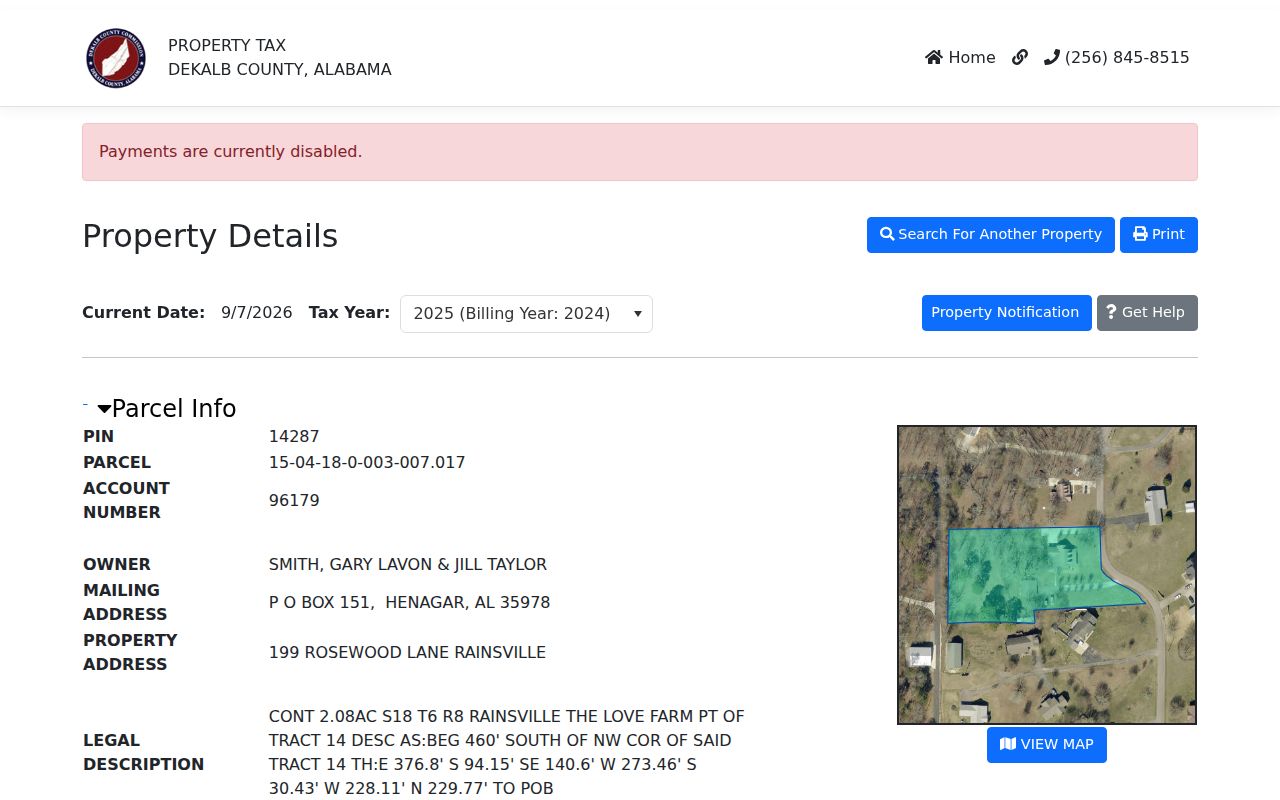
The card also lists parcel and building context. Photos are absent even though sketches exist. Assessment components are not a current inspection. Treating a sketch as proof of present condition is the mistake to avoid, since the card only documents what the assessor recorded.
Note: Value comparisons hold up only when source, year, class, and property components stay with the number.
Understand Alabama's Class III Ratio
Alabama assigns each property class its own assessment rate. The Alabama Department of Revenue assessment guide explains the classes and their rates in detail. Owner-occupied residential and agricultural land commonly falls in Class III at 10%. Confirm class on the parcel record.
- Appraised value
- The mass-appraisal figure before the class ratio.
- Assessment ratio
- The statutory percentage applied by class.
- Assessed value
- The result used in the property-tax framework.
- Reassessment
- A new valuation for a later assessment period.
The wrong class percentage ruins a comparison even when the appraisal is right. Keep class and year beside every DeKalb assessed value.
Estimate DeKalb County Property Value From Records
Use the address only to reach the parcel. The PIN and account numbers then anchor every later value check to that tract.
- Search the address in AssuranceWeb and confirm PIN.
- Record land, improvement, total appraised, assessed, class, and year.
- Review annual history without mixing billing years.
- Check the Probate deed index for sale consideration when relevant.
- Assessment year
- The year attached to the valuation.
- Improvement value
- The appraisal component assigned to structures.
- Consideration
- An amount recited in a deed, which may be nominal or nonmarket.
Open the deed image before logging any consideration. If the index shows a transfer, inspect the instrument itself. Gifts, estate deeds, partial interests, and other nonmarket events can carry amounts far from an open-market price.
Separate DeKalb Value History From Tax Status
AssuranceWeb can display several annual rows at once. Paid flags, billing years, and future labels chart change over time. They rarely explain the cause. Future-year rows appear before payment opens. So checkout status is not valuation evidence. One 2025 real tax payment of $1,539.08 is a tax fact, not a value estimate. A paid row proves neither clear title nor sale price. Chart appraised and assessed columns apart from payment status.
Apply Alabama's 7% Cap Carefully
The ALDOR 7% cap guidance describes eligible increases and its exclusions, such as ownership changes, new improvements, and reclassification. The cap shapes qualifying tax treatment. It is not a ceiling on sale prices or appraised market movement. Check for an exclusion before comparing year-to-year treatment. New work can raise improvement value, and reclassification can change the ratio. The cap never makes an assessment a forecast.
Explain DeKalb Improvements With Card Components
AssuranceWeb's building area, year-built, residence, barn, garage, and sketch fields can explain why improvement totals differ. They do not prove present condition or that every change was inspected. Note the source and selected year with the value.
| Card clue | What it may explain | What it cannot prove |
|---|---|---|
| Building area | Scale used in mass appraisal | Current measured area |
| Year built | Age factor on record | Renovation quality |
| Barn or garage | Listed components | Present condition |
| Sketch | Recorded outline | Boundary or sale value |
Compare DeKalb Sale Consideration Carefully
The parcel card lists no last-sale date or price. For sale comparisons, use the Probate deed index. Then open the instrument image. Save execution date, recording date, instrument type, parties, consideration language, and legal description. A recited amount may cover several parcels, a partial interest, or a transfer that was not arm's length. Even a valid sale reflects its own date and condition, not today's value alone.
Keep DeKalb Tax Districts With Each Value
Tax districts and annexation shape the tax framework. They do not change what appraised value means. A Rainsville situs, a Henagar mailing address, or a Collinsville mailing-city label settles nothing about jurisdiction. Rely on the parcel's tax district and a current boundary source. Matching appraised totals can bring different tax outcomes. Neither is a better sale estimate. Keep jurisdiction, class, year, and parcel components beside each number.
Note: Compare value measures here; use the DeKalb property tax page for bill, exemption, and appeal procedures.
Know What DeKalb County Property Value Cannot Prove
Keep the assessed value in perspective. It is a tax-system figure, nothing more. It will not predict an offer, and it will not prove a home's condition. It cannot settle a title question. It also cannot stand in for a licensed appraisal of DeKalb County property. The inspection card also leaves out the last-sale date and price. To recover those, you have to pull the recorded deed itself and read its consideration language. The instrument is where the real transaction lives.
Questions about an assessment go to the DeKalb Revenue Commissioner at 206 Grand Avenue SW, Suite 101, Fort Payne. You can also reach the office through the county portal. For a deed image, the Judge of Probate holds the records. Neither office will produce a private appraisal. It keeps value-related property records on file, but that is not the same service.
Value vs price. DeKalb County assessed value is used in taxation and is not what a property will sell for. Obtain a licensed appraisal for a current market opinion.