
Read DeKalb Property Tax Records
The Revenue card splits land from improvements. It also shows the billed amount, owner label, parcel keys, tax district, exemptions, payment state, and prior-year history. Each field belongs to one period.
| Field | What It Shows | Where |
|---|---|---|
| Appraised value | Portal estimate before the assessment ratio | Revenue card |
| Assessed value | Value to which millage is applied | Revenue card |
| Exemption fields | Codes shown for the selected account | Parcel detail |
| Tax and status | Amount, paid state, payer, and balance | Tax table and history |
| Tax district | District label used for the account | Parcel summary |
Alabama classifies property first. After the class comes a ratio, then millage. Residential property is commonly assessed at 10 percent, but the exact class and exemption on the card control, and neither appraised nor assessed value is a sale appraisal.
Search DeKalb Tax Seven Ways
The AssuranceWeb tax search accepts name, PIN, company, parcel, account, subdivision, and address, though name and company queries can collect several accounts at once. Address works for a known home. PIN or parcel is safer once verified, with situs and legal-description checks applied.
| Route | Best use | Risk |
|---|---|---|
| Address | Known site | Street variants |
| Name/company | Multiple accounts | Similar labels |
| PIN/parcel/account | Exact account | Old identifiers after parcel change |
| Subdivision | Plat-group lead | Not city-boundary proof |
Keep the selected tax year. The grid can show year and billing-year labels that look alike but sit in different display contexts.
The Revenue search visibly separates its tax-year selector from the lookup fields.
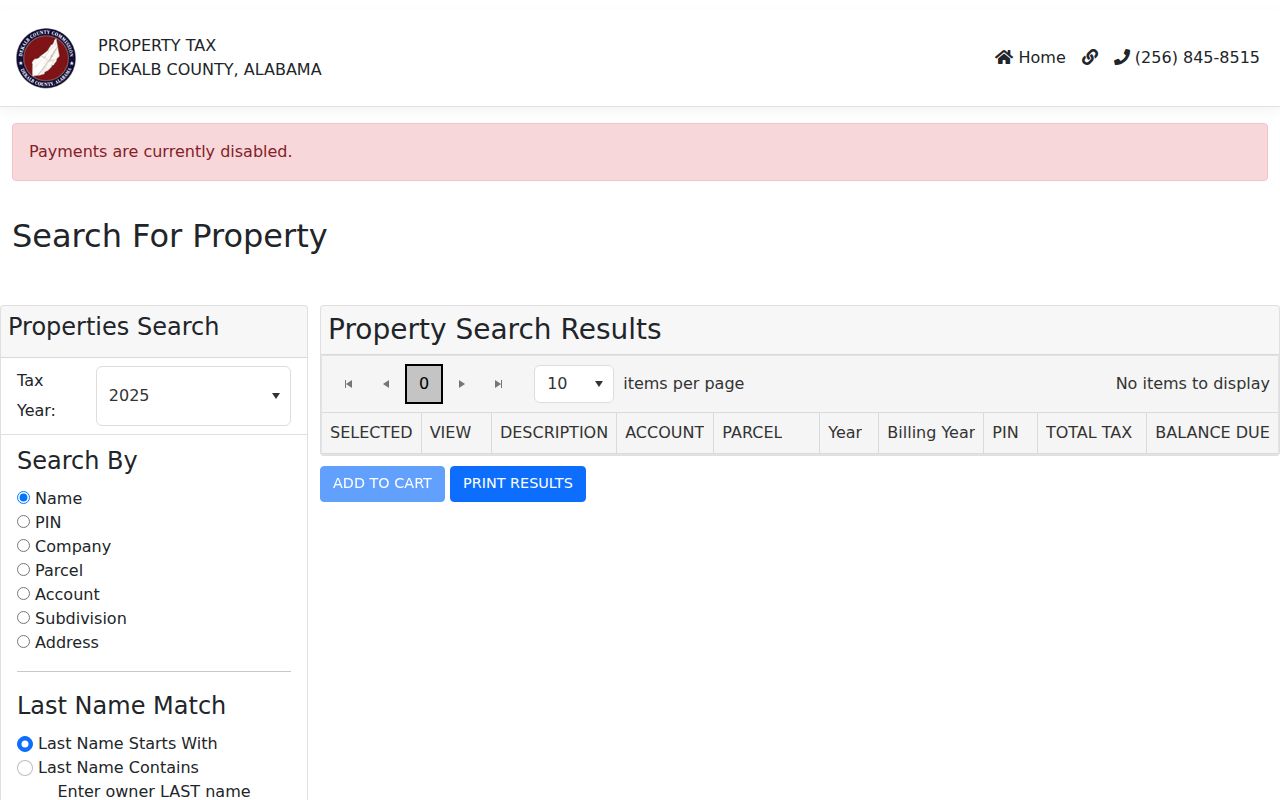
A year-first workflow precedes card and history comparison.
Rosewood Lane Tax Numbers
A Rainsville sample of 2.08 acres shows why. Its 2024 history row reports $393,620 appraised, $39,360 assessed, and $1,539.08 paid tax. The 2025 row carries different values, a payment by the named owner, and a selected-year area showing yet another amount. Copy the label with each number. DeKalb property tax records deserve year-specific citations. The sample is not a county average, a valuation opinion, or a statement about any other parcel.
DeKalb Exemption Codes Need Confirmation
H1, HS, tax-class, and similar codes fill the sample card. They are portal shorthand. No code is an eligibility ruling. Ask the Revenue Commissioner instead. The office explains current exemptions and applications, and no code establishes age, disability, occupancy, or veteran status, since public tax data only shows the parcel's assessment treatment.
Future DeKalb Tax Years
AssuranceWeb exposes year labels through 2027. Its payment function stays disabled for those years. The county GIS also carries a future-data layer for property not yet taxed. Search availability and payment availability are separate. Before acting, confirm the active year, due amount, and payment options with the Revenue Commissioner, because future data is not a final current bill.
Look Up a DeKalb Tax Bill
Start in AssuranceWeb and identify the exact parcel. Open the card rather than trusting the result grid, then compare the main tax table with the yearly history.
- Choose the intended tax year and search by address.
- Verify the parcel with PIN, account, owner, and legal summary.
- Read the tax, balance, paid state, and payment history.
- Check appraised, assessed, class, and exemption fields.
- Open the tax-sale section and search Probate for any tax lien.
- Assessed value
- The value to which tax rates apply.
- Millage
- Tax per thousand dollars of assessed value.
- Homestead exemption
- Qualified relief tied to use and eligibility.
- Tax lien
- A recorded claim securing unpaid property tax.
The sample card stated no tax sales found. That result covers one parcel only. DeKalb's tax-sale search lists separate parcel statuses, and a tax lien may stay recorded with Probate for up to ten years.
Paid DeKalb Taxes Do Not Clear Title
A paid row only marks one bill paid. It does not clear a mortgage, judgment, easement, restriction, tax-sale issue, or deed defect, so search each record family independently.
Keep tax and title separate. Payment history is not an ownership chain or title opinion.
DeKalb Tax Help Beyond the Portal
The Revenue Commissioner sits at 206 Grand Avenue SW, Suite 101, Fort Payne, and answers 256-845-8515. Counter and phone help pay off. Staff can untangle a code, an adjustment, a duplicate year, or an unclear payment status. The Rainsville annex adds area convenience. Confirm recording and certified copies there. Written requests work too. Under Alabama Code §36-12-40 and current procedures, a focused written request can identify a specific tax record, joining the online roll, counter, and phone as documented access channels.
DeKalb County property tax records often split value into parts. A card can separate the house from a barn, a garage, and land acreage. Building details run deep. Expect construction year, area, story count, materials, and systems. Those facts matter in an appeal. The roll may list a structure that is gone, record the wrong size, or assign the wrong use. Sketches and photos may be absent. Field evidence can still be necessary.
Read the annual history as a sequence, not a title chain. Each displayed year shows the tax, paid status, payer, appraised value, and assessed value. A payer may differ from the owner. An owner label can lag a deed. Use the history to explain value and bill changes, then take transfer questions to Probate deed records.
Tax districts are administrative clues. A Rainsville situs or Fort Payne mailing label does not by itself prove the parcel sits inside that municipality. Annexation and police-jurisdiction lines can shift. Alabama keeps current ordinance and map references. Confirm the official boundary before disputing a city levy or municipal service.
Delinquency work crosses offices too. The card may show a balance and a parcel-level tax-sale result. The county tax-sale portal can display status fields such as sold, redeemable, or redeemed, and a property-tax lien is filed with the Judge of Probate, where Alabama guidance gives it a ten-year life. Check the lien and any release rather than treating a paid current bill as the full history.
Appeal a DeKalb Assessment
Verify the parcel facts first. Then ask Revenue about review with the Board of Equalization. Gather the current card, photos, measurements, comparable evidence, and any documents showing a factual error, and note that Alabama publishes both preliminary and final assessment appeal routes.
Watch the notice date. Alabama gives 30 calendar days for a preliminary assessment appeal and 60 days for a final assessment appeal. Confirm which process governs the DeKalb notice.
Alabama's 7 percent cap may limit some annual value growth. Statutory exclusions apply. A cap does not replace an appeal. Nor does it decide whether the base record is correct.
Keep copies of the notice, portal card, submitted evidence, and any office response. Record when each item arrived or was filed. A preliminary assessment challenge, Board of Equalization review, Tax Tribunal route, and circuit-court appeal are not interchangeable. Each one serves a different purpose. The governing notice and Alabama instructions set the next step. Ownership or deed issues belong with Probate, not the tax appeal process. Route them accordingly when the dispute is really about the property's listed facts or value.