
Start a DeKalb County Property Records Search
Where you start depends on the clue you hold. An address, PIN, parcel number, or account number points straight to the DeKalb Revenue Commissioner's AssuranceWeb system. An owner name works there too. A deed party name, by contrast, belongs in the Judge of Probate index. When the question is about location, the county GIS viewer is the bridge. It covers nearby parcels, subdivisions, and section-township-range geography. Each system has a separate job. Keeping identifiers from the first result makes every later search more exact. Just remember the limits: a mailing city does not prove the land sits inside that city, a tax owner label is not certified title, and a drawn parcel line is not a survey. Carry the same identifiers everywhere.
- Search AssuranceWeb by situs address and save the PIN, account, parcel, owner label, tax district, and subdivision.
- Repeat the PIN or parcel in the DeKalb County property search workflow and GIS to catch formatting or address differences.
- Use owner and prior-party names in the Probate deed, mortgage, plat, miscellaneous, and all-books indexes.
- Compare the legal description, deed book and page, tax year, and recorded date instead of matching on a name alone.
- Request the recorded image or a certified copy from the custodian when the document itself matters.
The Offices Behind DeKalb County Property Records
Three county functions supply most DeKalb County property records. The Judge of Probate records deeds, mortgages, plats, UCC filings, and miscellaneous instruments. The Revenue Commissioner keeps the assessment and the tax account. Its public GIS adds the parcel geography. Court disputes over liens, foreclosure, partition, estates, or quiet title may also need the DeKalb Circuit Clerk. These offices share identifiers, but none substitutes for another.
Judge of Probate, Recording Office
300 Grand Avenue SW, Suite 100
Fort Payne, AL 35967
(256) 845-8510
Revenue Commissioner
206 Grand Avenue SW, Suite 101
Fort Payne, AL 35967
(256) 845-8515
DeKalb Circuit Clerk
300 Grand Avenue South, Suite 200
Fort Payne, AL 35967
(256) 845-8525
Probate's recording office sits in Fort Payne. Hours run Monday through Friday, 8:00 a.m. to 4:00 p.m. Counter service, telephone contact, and office copy requests still matter when an online result is unclear or an older book is not easy to view.
Seven Ways Into DeKalb County AssuranceWeb
AssuranceWeb offers more than a simple address box. Its search screen separates name, PIN, company, parcel, account, subdivision, and address modes. The address option splits street number from street name. Name searches take a last name, an optional first name, and starts-with or contains matching. Those choices matter. Punctuation, initials, trusts, or company labels can make an exact-looking query miss the record.
| Search key | Best use | Cross-check |
|---|---|---|
| Address | Known situs location | PIN and parcel |
| Owner or company | Find a labeled portfolio | Mailing city and legal description |
| PIN or account | Open one tax card directly | GIS and selected tax year |
| Parcel | Match the formatted county identifier | Deed book and page |
| Subdivision | Find a named development lead | Recorded plat |
The results grid can show description, account, parcel, year, billing year, PIN, total tax, and balance due. Save those labels before switching screens. The portal may display a selected tax year beside a separate billing year. Note which year belongs to each figure.
A DeKalb County Parcel Card Is a Crosswalk
The AssuranceWeb card for account 96179 shows why a parcel card works best as a crosswalk. It gathers the owner field, separate mailing and property addresses, PIN 14287, the formatted parcel number, tax district, exemption code, subdivision, deed-book clues, section-township-range, acreage, improvements, and yearly value history. None of that is title evidence. Read the card as a source of search terms instead. Its precise labels feed directly into the GIS and Probate systems. That is where a parcel card earns its keep.
Keep these terms straight. A PIN is the county's property identifier across tax and GIS screens. A parcel number encodes land geography. An account organizes the tax record, while a legal description identifies land in record language. A plat maps lots in a recorded subdivision.
The sample also separates a Henagar mailing address from a Rainsville property address. That gap is a useful warning. Where mail goes and where land lies can differ. Let the tax district and the parcel geometry lead the location analysis. Municipal boundary material and the recorded description belong there too. Dates deserve the same care as places. One DeKalb County parcel can carry a deed execution date and a later recording timestamp. It may also carry an assessment year and a separate billing or payment year. Write down all four. Calling one item the latest record can hide a real timing gap. So name its system. If the tax card and a newly recorded deed name different parties, keep both results and their dates. Then decide the next step from there. Ask the proper office about the update rather than assuming either screen is wrong.
DeKalb County Deeds Use a Name-Centered Index
The DeKalb Probate records application organizes searches by All Books, Deed, Incorporation, Marriage, Miscellaneous, Mortgage, Plat, and UCC. Its deed search is name-centered. Parcel-number searching is not offered. Move from a tax or GIS result into the deed index with the owner label, deed book and page, legal description, and possible grantor or grantee names. The deed interface carries a valid-date message beginning June 1, 1947. An unbounded query returns earlier rows anyway. Some date to 1919. That inconsistency is a lead, not proof of complete online coverage. For an older chain, contact Probate about the book and image. Then check the Alabama Department of Archives and History microfilm finding aid. Guest viewing of selected documents costs $1 per page. The office fee page lists uncertified copies at $1 per page, with certified copies at $3 per instrument plus $1 per page. Confirm charges and image availability before ordering.
One Recorded Deed Shows Why Index Data Need the Image
Consider instrument 4668. It is a July 14, 2025 entry in deed book 3005 of the DeKalb County deed index. It names three forward parties and two reverse parties. Yet the legal-description field comes back blank. The displayed page counts disagree. In short, the row locates the instrument but stops short of its contents. It does not transcribe it.
The official instrument-detail response shows what the full record actually holds. The recorded pages carry the description, recitals, signatures, and any consideration language. Treat an index row as a route to the record, not a substitute for it. When title, an easement, a restriction, or a transfer term matters, inspect the image. Then seek a certified copy or a professional title review as appropriate.
What DeKalb County Property Records Document
Different files answer different property questions. DeKalb County property records work best as a set. The recorded instrument supplies the legal acts, while the tax card carries the assessment account. Add the GIS for a mapped reference, and turn to court or probate files for disputes and estate authority.
| Local record | Question it can answer | Official custodian | Access route |
|---|---|---|---|
| Deed | Who conveyed an interest, to whom, and when it was recorded | Judge of Probate | Online index, counter, copies |
| Mortgage, lien, UCC, miscellaneous | Which recorded claims or related instruments need review | Judge of Probate | Category and all-books searches |
| Assessment and tax card | Owner label, situs, values, exemption code, taxes, and history | Revenue Commissioner | AssuranceWeb, office, phone |
| Parcel map and attributes | Mapped parcel, PIN, subdivision, S/T/R, deed book/page leads | Revenue Commissioner GIS | Public map, identify, export, print |
| Plat | Recorded subdivision lots, roads, and plat references | Judge of Probate | Plat index and recorded image |
| Civil or estate case | Orders affecting foreclosure, partition, quiet title, or an estate | Circuit Clerk or Probate | State docket, counter, certified copy |
A paid tax line does not establish clear title. Mortgages, liens, judgments, deeds, tax-sale material, and court orders each live in a separate search, with its own date and custodian.
The DeKalb GIS Adds Map Context, Not Survey Proof
The DeKalb Revenue parcel viewer searches both current and future parcel layers several ways. Query by owner name or parcel number. PIN, section-township-range, and subdivision work too. A result can include owner and mailing fields, parcel and PIN, subdivision, S/T/R, deed book and page, and a details link. The map also offers identify, measurement, printing, imagery, an attributes table, and export tools.
Measurements are approximate. Data come as-is and need independent verification. Future parcel data have not yet been taxed. Use the geometry to orient a deed or plat search, spot nearby parcel IDs, and compare descriptions. For a boundary conclusion, rely on a recorded survey or a licensed surveyor.
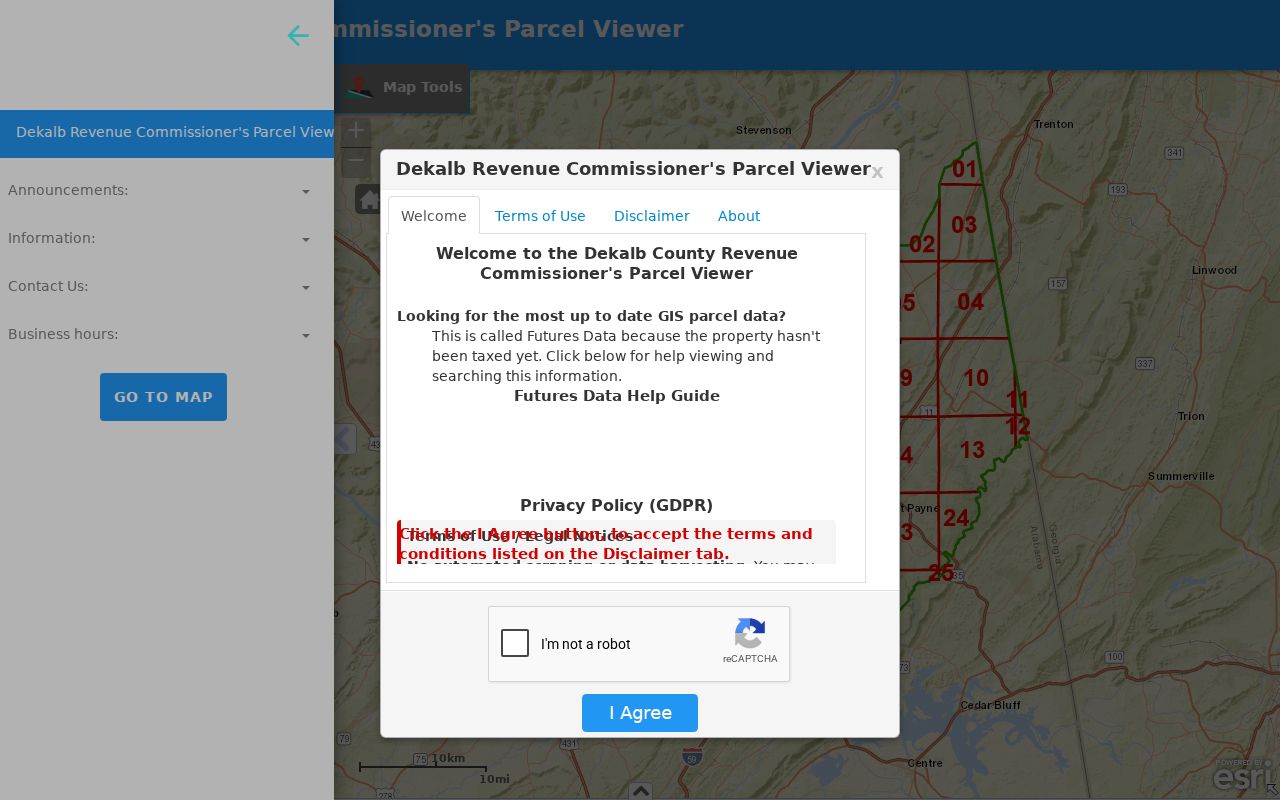
The parcel viewer's real payoff is context. It connects a mapped location to identifiers that lead back into the assessment rolls and the deed books of DeKalb County.
Tax Years Can Point in More Than One Direction
Tax years can point in more than one direction. The AssuranceWeb portal lists tax years through 2027. Payments on the page are disabled. A sample DeKalb card even showed selected-year values that did not line up with its own tax-history row for the same label. Keep the selected tax year, billing year, portal date, amount type, paid status, and balance as separate facts.
Read the label before the number. A future assessment row is not a current bill, and a zero balance on one selected account does not establish countywide tax status.
Alabama makes ad valorem taxes due October 1. They become delinquent after December 31. State guidance covers property classes, ratios, and millage. A statutory seven-percent cap limits annual increases in taxable value for qualifying property, subject to exclusions. Apply those rules to DeKalb County's actual card and classification rather than estimating from a headline number.
DeKalb Plats Join Modern Addresses to Older Land Language
A named subdivision on the tax or GIS screen is where a plat search starts. Take the Love Farm Sub card. It pairs a modern Rainsville street address with code LFA001, deed book and page 641/205, a tract-based metes-and-bounds description, and section-township-range 18-6-8. The lot and block fields sit blank. One blank field cannot erase the other recorded leads.
Final subdivision plats are recorded in the Judge of Probate office and receive plat-book, page, or slide references. County subdivision rules apply in unincorporated areas. Cities may impose their own requirements, even extra-territorial ones. E-911 approves road numbering and addressing for county plats. Search the Plat and Deed categories separately, since development approval and final recording are distinct events.
Older DeKalb County Property Records Have an Archive Route
Older DeKalb County property records have an archive route. The Alabama Department of Archives and History keeps a County Records on Microfilm finding aid. It covers deeds, wills, estate files, marriages, guardianships, and limited birth and death registers. Many originals stay with the county office. Start with a current deed book and page. Work backward through Probate for chains that outlast the online display. Ask which older volume or reel holds the next link.
Fort Payne address history has an extra tool. The Library of Congress holds white pages covering March 1951 through March 1973 in 251 images, plus a later collection lead through 1980. ADAH's directory finding aid lists Fort Payne directories for 1969 and August 1990. Directories link people to old street addresses. They are not deeds and prove no title.
Older business ownership may need another handoff. The Alabama Secretary of State warns that corporation records from 1949 through 2010 may sit at ADAH rather than in the current electronic entity search. A company-named parcel calls for comparison. Compare the current entity record with the historical archive lead, then weigh the recorded deed parties, any mortgages, and the property's legal description. A matching business name alone is not enough.
Municipal Lines Change the DeKalb Records Trail
Deeds, assessment rolls, tax bills, and parcel mapping all stay at the DeKalb County level. That covers Fort Payne, Rainsville, and Collinsville alike. City records add a different layer. Fort Payne handles permits, zoning review, and inspections. It posts applications for building, trade, demolition, and subdivision work along with inspection contacts. Rainsville lays out a 2024 subdivision process. It runs through preliminary and final plat steps before approval. Collinsville keeps its zoning rules, building codes, and historic-business-district ordinances on hand for anyone dealing with property inside town.
Never read a mailing city, ZIP code, or subdivision name as proof of a municipal boundary. Even the tax district can mislead you there. Annexation and police-jurisdiction records need an effective date to mean anything. They belong beside county parcel geometry and the city's own files. The three city guides keep those local distinctions intact instead of forcing one countywide guess. DeKalb County property records answer the county questions. The cities answer the rest.
Limits of DeKalb County Property Records
DeKalb County property records carry real weight, but they answer only certain questions. A deed record shows recorded parties and instruments. The tax roll lists the owner label, assessed values, tax bill amounts, and parcel references. None of that proves who lives at a property. No record establishes a surveyed boundary or predicts a sale price. Keep timing in mind too. The county publishes no fixed roll-update schedule, so a freshly recorded deed can postdate the owner label on a tax card.
Alabama Code §36-12-40 gives residents the right to inspect and copy public records. That right is subject to exceptions. A request works best when it names the record and its custodian with reasonable specificity. Access can still narrow at the edges. Court privacy rules, sealed files, vital-record restrictions, protected security material, and confidentiality programs all place parts of the files off limits.
Use records lawfully. Public access supports purchase research, estate work, boundary questions, tax review, and civic transparency. It does not permit stalking, intimidation, or harassment, and it does not replace a title professional or surveyor.