
Reconstruct DeKalb County's Former-Owner Timeline
The fastest start is one confirmed transfer concerning your parcel. Build a single row for every deed you find. The public DeKalb Probate records search covers Deed, Mortgage, Miscellaneous, Plat, UCC, Marriage, Will, Corporation, and Estate book groups. Choose Deed for the ownership chain. Treat the other groups as supporting trails rather than as conveyances.
| Source | Years It Covers | Where Held | What It Shows |
|---|---|---|---|
| Probate deed index | Interface states 1947 forward | Online Probate portal | Parties, dates, type, instrument, book/page |
| Older deed books | Earlier years as held | Judge of Probate and microfilm | Recorded transfers and legal descriptions |
| Recorded plats | Varies by subdivision | Probate Plat book group | Lots, roads, easements, amendments |
| Estate and court files | Case-specific | Probate and Circuit Clerk | Events that explain a break in the deed sequence |
A timeline gives the chain order and proof. Each row marks one former owner of a DeKalb County parcel and works as a research worksheet, never a title opinion. Keep the legal-description clue.
Test DeKalb's Online Date-Range Quirk
The Probate search interface lists January 1, 1947 as its start date, yet index rows reach back to 1919 Smith entries. Treat that gap carefully. The tool's cutoff is no promise of complete online coverage for either year. Search the useful window. Preserve the details. Then ask Probate staff where older or omitted books can be examined.
Keep a search log. Record each query, date range, and book group. A written record lets Probate staff point you to a courthouse book, an image, or an archival copy when the web form cannot establish completeness.
Note: An index cutoff describes the search tool, not the first year land ownership existed in DeKalb County.
Read a DeKalb Deed Entry Before Going Back
Instrument 4668 in book 3005 was recorded July 14, 2025. The entry is plain about its identifiers. The official Probate instrument view shows the deed image. Its fields let you return to one record without confusing it with another party-name hit.
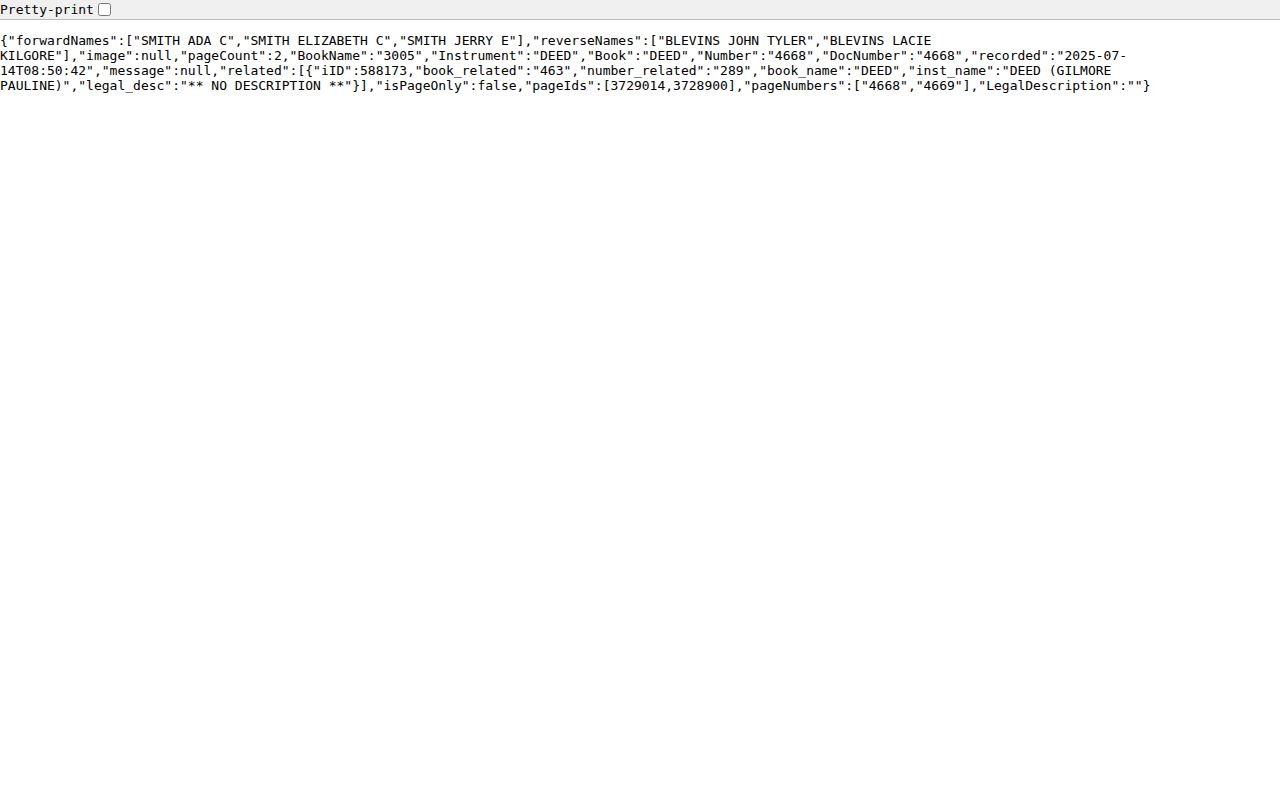
Read the image alongside its index fields. Save the instrument number, book, page, recorded date, grantor, grantee, document type, and legal-description text before stepping back to the prior acquisition.
Go Back Through DeKalb County's Deed Parties
Each seller becomes the next search subject. That is the rule. Addresses may postdate the deed and parcel numbers can change after a split or replat, so party names and legal descriptions carry a DeKalb County ownership search across time.
- Locate the newest deed for the parcel and confirm the current grantee.
- Read the grantor exactly as indexed, including initials, entities, and co-owners.
- Search that grantor as a grantee in an earlier date window.
- Compare acreage, subdivision, lot, block, and section-township-range clues.
- Repeat until the web index stops, then carry book and page references to older volumes.
- Grantor
- The party conveying an interest.
- Grantee
- The party receiving the recorded interest.
- Chain of title
- The linked sequence of instruments affecting the parcel.
- Reverse index
- A party-name route used to locate an earlier acquisition.
Bridge Changed DeKalb Parcel Descriptions
Modern GIS and AssuranceWeb records may show a PIN, account, parcel number, subdivision, plat book and page, acreage, and section-township-range. These systems track the same land in different ways. Older deeds lean on metes-and-bounds text or a lot-and-block description. When an identifier changes, compare the land itself. Never force the old deed into today's parcel number.
The Love Farm example ties a modern Rainsville address to a named subdivision, plat reference, tract wording, and section-township-range. Several systems can point to the same land. Each stays a distinct record. So note every bridge. Mark any mismatch in the timeline.
Add DeKalb Estate and Court Transfer Clues
Chains break at estates, divorces, foreclosures, and quiet-title suits. A deceased owner simply vanishes from the deed trail. Turn to the Probate Estate and Will groups then.
The DeKalb Circuit Clerk maintains circuit and district files and addresses copy access. An order there can explain why the next deed names a fiduciary or a different party. The court explains the event. The deed recorded by Probate remains the land-record step to match against the parcel. Keep case number and each date separate.
Follow DeKalb's Santileon City Land Story
Rainsville history says its downtown was promoted as Santileon City during railroad speculation. That story hands you search terms. Try Santileon City, Parker Town, Dixie Lookout Realty, and names tied to the 1914 promotion. It proves no lot was ever sold.
Use the old names in historical pages, newspapers, maps, and archive catalogs. Test them in Probate Deed, Plat, and Miscellaneous records. Only the original instrument settles whether a parcel transferred. The story becomes a disciplined lead for former-owner research in DeKalb County.
Continue DeKalb Former Owners on Microfilm
The Alabama Department of Archives and History county-record search lets you pick a county and record type. It then shows microfilm holdings. Many originals stay with the originating office, ADAH notes. Archival discovery and certified-copy custody are two different things.
Take your questions to the Judge of Probate. The office sits at 300 Grand Avenue SW, Suite 100, Fort Payne. Hours are Monday through Friday, 8:00 a.m. to 4:00 p.m. Bring the last confirmed book, page, party, date, and legal description. Ask whether the needed volume sits locally or through ADAH.
Keep DeKalb Tax Names Out of the Deed Chain
Tax history has its place. An annual Revenue card can tie a taxpayer name to a specific assessment year in DeKalb County. But it is not a chain of former owners. A single tax row names no instrument, no grantor, and no legal description of the interest conveyed. Use the tax roll to narrow a period or confirm a parcel number. Then go back to the recorded deeds themselves.
Be careful when payment status sits next to future labels in the same records. A paid tax bill proves nothing about clear title. It does not prove that every ownership change reached the deed records, either. Keep the tax year and billing year attached to each observation. That keeps the timeline honest.
Define the Reach of DeKalb Ownership History
DeKalb County was established in 1836. Its courthouse moved through Willstown, Lebanon, and Fort Payne before settling in Fort Payne. That custody story frames where old records might live. It does not mean every early instrument is online. For any given era, the 1947 interface limit, the older API result, courthouse volumes, and ADAH microfilm all have to be reconciled. Only then should you trust the picture.
Know when to stop and ask. A missing deed image, ambiguous party roles, a description that changes without a clear bridge, or an intervening estate order all call for help. Ask the office. The Judge of Probate contact page is the recording-office route. The DeKalb deed records page covers single-copy mechanics.
Lawful use. Trace prior owners for property history, estate research, or purchase diligence. Never use the record trail to target or harass a living person.